expr:class='"loading" + data:blog.mobileClass'>

Pages

Showing posts with label book marketing. Show all posts

Wednesday, June 3, 2015

IDPF, The International Digital Publishing Forum, Discusses Book Discovery Tactics

How many of us have even heard about the IDPF? Well, this forum has been around for about 16 years and was part of the 2015 Book Expo America Conference that was just held 26 thru 29 May 2015.

'The International Digital Publishing Forum (IDPF) is a trade and standards association for the digital publishing industry, that has been set up in order to establish a reliable and complete standard for ebook publishing.
This is the organization responsible for the EPUB standard currently used by most e-readers.
Starting from the Open eBook Publication Structure or "OEB" (1999), which was created loosely around HTML, it then defined the OPS (Open Publication Structure), the OPF (Open Packaging Format) and the OCF (Open Container Format). These formats are the basis for the common EPUB and Mobipocket ebook file formats (Comparison of e-book formats).
While the basic standards are now established (pages, hyperlinks, definition of table of contents, authors, etc.), some other standards intersect the hardware field, such as those for power and for features of the hardware reader devices, and are still undergoing change and evolution. Other standards for ecommerce (including Digital Rights Management protections), are tied to the way the ebook is sold or delivered, and are therefore controlled by the respective vendors.' - Wikipedia

The BEA's IDPF conference last Tuesday discussed ways/means and tactics of getting your digital books discovered in today's world of intense overload. There were a few golden book marketing nuggets thrown out at the conference. 

Tonights research source is from Publishing Perspectives and was written by Erin L. Cox and Edward Nawotka:


Where’s Waldo the Reader? Book Discovery Tactics from IDPF

Executives from Goodreads, HarperCollins, and Penguin Random House shared book discovery tactics in the age of overload at BEA’s IDPF conference last Tuesday.

When we talk about discoverability in sales meetings and publishing conferences, we speculate about how readers “discover” books, but, in actuality, readers are discovering, discovering, discovering all day.
A message that has been repeated throughout today’s IDPF conference is that readers are overwhelmed with content and media that they discover (just think of your last YouTube wormhole or the hours lost on Twitter/Facebook reading articles you didn’t know you would be interested in that were posted by friends), and books are no different. What publishers need to drill deeper into when they talk about discoverability is what Porter Anderson, Futurebook editor and moderator of “The Fracturing Book Discovery Landscape: How to Find Your Readers,” said, “[publishers] need readers to discover what we NEED them to discover.”
But, how and where and when do publishers do that to be effective? There doesn’t seem to be one answer to those questions. Instead, it depends on the book, the publisher, the budget, and the readers.
Amanda Close, Senior VP and Director, Consumer Marketing and Development & Operations Group, Penguin Random House said that publishers pick avenues to meet the reader either in a space where they might be thinking about reading or perhaps where they are not thinking about reading, depending on the book. “We really want to meet readers where they live and where they spend time and are thinking about other things. I think we are all thinking about how to get to readers and connect them with the brands, books and authors they really want to engage in,” she said.
Angela Tribelli, CMO, HarperCollins, said, “The most immediately valuable consumer for us has the highest intent to purchase. We need to know when to borrow audience, engage with the one that already is there, or whether to build our own. We might to think we are very close to that purchase intent. We want to reach all people who are reachable through traditional marketing channels. I’m interested in leveraging audience that we can reach on a day-t0-day basis.” As an example, HarperCollins created a partnership with the fast food chain Chipotle to feature quotes from more literary or philosophical writers such as Paulo Coelho, Barbara Kingsolver, and Amy Tan on the packaging of their food and also the partnership with JetBlue to feature their samples of their bestselling ebooks for free on the airline’s Fly-Fi Hub.
With the glut of content out there, curation is necessary for discovery, whether that be publishers working with a bookseller, media, or an individual reader recommending books to a friend.
Otis Chandler, CEO of Goodreads, best described the title of the panel — fracturing of the book discovery landscape — Goodreads now boasts 40 million users with 14 million books being marked as “to read” each month, many through recommendations from friends.
The focus for the company — which is owned by Amazon — going forward, will be focused on mobile. “What we are seeing now is ‘half-mobile.’ I have a challenge to try and never let a good recommendation get lost in the ether. We did a survey of our avid readers and found 48% are reading are reading on their mobile devices, and 80% were women. 1/3rd are using their mobile device as a backup device. That really opens up opportunities for marketers on how to drive into books.”
Publishers successfully tap into this audience of engaged, influential readers through print and ebook giveaways (though ebook giveaways tend to be less successful) and encouraging authors to share their recommendations. Chandler noted that authors are not leveraging their platforms enough. The core question is whether “people are people talking about books,” he said.
Can you define the quintessential influencers: micro-celebrities, authors, book bloggers and power users who have big influence in their respective genres. So, on the first ones, Bill Gates just released his summer reading list, “which is really interesting to our readers,” said Chandler, who also called out the work of Brian Johnson, an entrepreneur, who offers daily tidbits and tips on self-development from various books and other sources.
Much of what publishers tend to do is to tap into existing readers, but what of the “potential reader?” Peter McCarthy, Co-founder, Logical Marketing, advised publishers to look at the way people view their lives when they are not reading. Seeing that entirety of their lives will help define what books might be of interest to them that reading data points alone would not necessarily point to. “Reaching hardcore readers is more narrow-casting than broadcasting,” he said. “Digital media is about seeing the influence of the niche influencer — they have a big bat and when they swing, they swing hard. Look at something like programmatic advertising and other consumer goods and you find audiences who want what you have as soon as you publish it.”
The personal connection — whether that be through the recommendation by a friend or providing desired content in a space and format that a reader wants it — continues to be the best way to get readers to discover books.
The Writers Welcome Blog is available on your Kindle here :)


Thursday, July 10, 2014

A Marketing Test for Your Book? --- You KNOW You Need One, Right?

A lot of talk about book marketing has been going around lately --- Actually, talk about marketing books has been going around since the beginning of ‘book time’ --- It has just taken a 
more center stage in this new era
where more writers are acting as their own publishers.

We all come to realize sooner or later that writing the book is just phase one of the book project. Getting the damn book in front of readers, phase two, is also of paramount importance to its success and, by extension, the writers sense of achievement (not to mention financial reward).

‘If you’re writing for a major publishing house, you will probably pass the marketing test before your book gets accepted. Books are chosen based on marketing appeal as well as the author’s writing skill and timeliness of topic.’ --- Cathy Goodwin, Phd.

When do you start your book marketing strategy? When you first start laying out and diagramming your new book storyline; even before you write the first word!

You do this by designing a marketing checklist that you apply as you build your new storyline. An example is defining or fine tuning your story so it fits into a particular genre; this lends your book to easier marketing trends/strategies and placement in bookstores. This singular built-in marketing concept will also invite more professional reviews and reviewers.

Nonfictional books already have a built-in marketing checklist, of sorts, in the form of their ‘Book Proposals’, which must be submitted before approval by major houses. Book proposals address such things as: Market for your story and demographics of proposed readership, why your book is different from others of similar subject matter, table of contents of your proposed book, proposed summary of the chapters of your nonfiction work, etc.

Now, this by Cathy Goodwin, PhD, published author, copywriter, writing coach, top reviewer and speaker.


Does Your Book Pass the Marketing Test? A Reviewer’s 7 Point Checklist


Authors frequently think of “book marketing” when the book is printed and ready to hit the shelves. In fact, nonfiction book marketing begins before you write the first line. After your book has been written and published, you and your marketing team will have to look for marketing copy, reviewers and more.
If you’re writing for a major publishing house, you will probably pass the marketing test before your book gets accepted. Books are chosen based on marketing appeal as well as the author’s writing skill and timeliness of topic. When you write for yourself or for a smaller house, of if you don’t have a promotion budget, you are on your own.
Before you come to the final moment when you say, “This book is finished!” here are 7 points to check off.
1. Your book belongs to ONE genre and you know ONE place where it belongs on a bookstore shelf. Mixed genres (such as self-help plus memoir) rarely succeed in the marketplace.
If you’re not sure what genre is, or what genre best characterizes your book, you’ll need to visit a bookstore, talk to some people and get some professional advice. Without understanding “genre,” you can’t market you book or get reviewers.
2. Your book has a simple theme that you can state in a sentence or two. When someone asks, “What’s your book about?” you can’t go on for ten minutes. You need a concept statement that lets the reader know exactly what the book is about. You’ll need this statement when you look for book reviews.
For instance, my relocation book’s theme was “the psychological aspects of moving.” Sometimes I would add, “Lots of books tell you how to pack a box; this one tells you how to pack your life.”
3. Your book fits together with a simple unifying premise that can be explained easily. For instance, my relocation book was premised on, “Relocation changes your identity in three ways.”

4. Your chapter titles expand the theme and also read like copywriting headlines. Readers will pick up your book and skim the table of contents. You’re selling them on the importance of digging in.

5. Each chapter has hooks that grab the reader’s attention. When you hook the reader in the first paragraph, you’ve probably got a reader who will finish the chapter and continue to the next one, until the book is done.

6. You know what the book adds to the existing possibilities. If asked, “How is your book different?” you have a clear, accurate response.

7. Your book is written concisely. Recently I was asked to review a memoir with a fascinating premise. But when I saw the book was 500 pages of tiny type, I gave up. A few books can get away with monumental size, usually if the author is famous to the point of notoriety. Most will end up as doorstops.

When your book passes this checklist, you’re likely to get awesome reviews, and you won’t have to struggle to get them.

The Writers Welcome Blog is available on your Kindle here :)))


Article resource: http://wordpreneur.com/16532/does-your-book-pass-the-marketing-test-a-reviewers-7-point-checklist/

Wednesday, January 23, 2013

Covers for Books and Magazines = Marketing Supremo


Book Covers Sell
Books
'Put on your best face', 'Put your best foot forward', etc., etc., are sayings that convey making the very best first impression.
 
Marketing yourself, so to speak.
 
In the case of books and magazines, the covers ARE
the first impressions and the ultimate, initial marketing impacts (enormous sales made just from covers).
 
 
What do you think are the best secondary and on-going marketing impacts? - This writer thinks its probably reviews, word of mouth and social media today.
 
Anyway, I thought a review of the critiques of leading magazine covers for 2012 given in the December, 2012, FOLIO: magazine would be enlightening and fun: 
 
Every month, FOLIO: selects a small group of designers and art directors to offer critiques on visually-engaging magazine covers. The cover, after all, is the first point of entry for any magazine, retail or otherwise.

This past year has produced a variety of arresting cover images that are designed to capture the attention of a reader and, ultimately, capture a sale. Here, FOLIO: rounds up six designers—including our own—and asks them to weigh in on their favorite cover of the year.

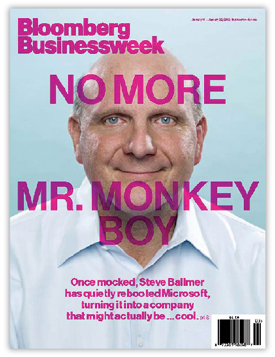
TITLE: Bloomberg Businessweek
ISSUE: January 16-22
CIRCULATION: 993,267
PUBLISHER: Bloomberg L.P.
CREATIVE DIRECTOR: Richard Turley

“I remember the moment I first saw this issue on the stands—I either said, or maybe just thought, ‘Oh, _ _ _ _.’ I know it’s not for everyone, it’s not slick—it’s sick. I know, it’s not fair, as art director Richard Turley is allowed to do anything he wants over there, but the thing is, he does it!

This could have been the hundredth iteration, or the first one just tossed off. Who cares? It’s more powerful and memorable than any of the made-by-committee, hand-lettered, 10-color covers around. The ‘What Me Worry?’ photo reminiscent of MAD magazine, the crazy cover lines and their placement, the garish overall one-color scheme—what’s that doing on a commercial, serious, nay, kind of boring, business magazine? It’s being awesome, that’s what.”
- Helene Silverman, Design Director, Architectural Record

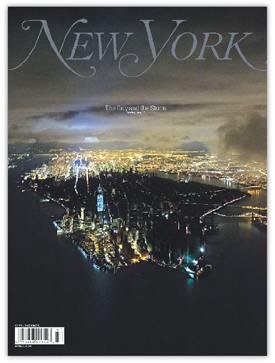
TITLE: New York
ISSUE: November 12, 2012
CIRCULATION: 405,149
PUBLISHER: New York Media LLC
DESIGN DIRECTOR: Thomas Alberty

“Few covers this year had as much visual and emotional impact as New York magazine’s cover story on Hurricane Sandy. In this day and age when newsstand sales dictate that covers be loud and garish with multiple cover lines and inane promises (BETTER SEX NOW! KILLER ABS IN 7 DAYS!), it’s refreshing to see a sober and simple approach to such an important topic. The cover photo—showing a divided Manhattan—and the restrained use of type speak volumes. The work is both stunning and somber and should remind all art directors that an effective cover need not yell at its audience.”
- Todd Johnson, Creative Director, D Magazine Partners

“This has to be one of the toughest assignments I have had this year—to pick my favorite cover from the last 11 months. To make sure I had covered my bases I searched covers online, went to websites of my favorite magazines, reviewed blogs, and looked through the piles on my shelves. But, in the end, I chose the cover of a magazine sitting on my coffee table (yes, it was actually on my coffee table).

The November 12 cover of New York magazine, “The City and the Storm,” is successful on multiple levels—for graphic impact, telling a story, maintaining a brand, and paying attention to the details of design. And the magazine staff managed to create this cover and issue while dealing with their own loss and devastation.
When you first look at this cover it is quiet and poetic. But then it pulls you in and makes you wonder what it would feel like to be on one of those dark streets, cold apartments and wrecked homes. In the Letter from the Editors they note selecting this image for the cover was “the easiest part of a harried three days…the clear choice for the way it fit the bigger story...about a powerful city rendered powerless.” I have not lived in NYC since 1995, but New York magazine always makes me feel connected through its honest celebration of the city and people.

Finally, the design of the cover celebrates the photo with a subtle logo, small headline, and date in black. All the details sit back and let the photo tell the story. Beautiful.”
- Kelly McMurray, Creative Director, 2communiqué

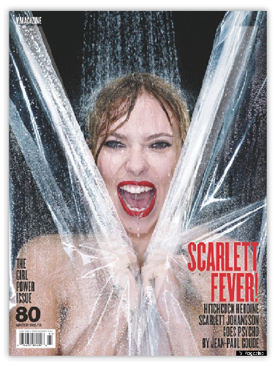
TITLE: V Magazine
ISSUE: Winter 2012/2013
CIRCULATION: 100,000
PUBLISHER: Visionaire Publishing
ART DIRECTOR: Sandra Kang

“A naked Scarlett Johansson on your cover is probably enough for newsstand success. But the creative team at V Magazine didn’t simply rely on the ‘sex sells’ mantra for their Winter 2012/2013 cover. This issue features the lovely actress recreating the iconic Psycho shower scene and there are really a lot of great things going on with this cover.

The image itself is striking and immediately recognized by most readers. It’s also cleverly cropped and composed, allowing the “V” logo to nicely blend into the shower curtain. Cover lines are kept simple and sparse, letting the image remain the focal point. Finally, the story and image are also relevant and timely, coinciding with the release of the new biographical drama ‘Hitchcock,’ which was released one week after this issue hit newsstands. All these things add up to a unique, clever, intriguing, and well-composed cover!”
- Daniel Trombetto, Creative Director, R7M Publishing (Publisher of FOLIO:)

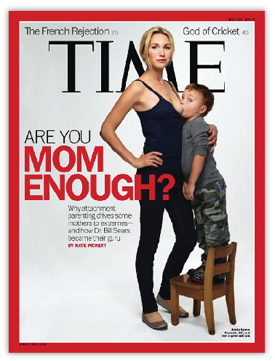
TITLE: TIME
ISSUE: May 21, 2012 | Vol. 179 No. 20
CIRCULATION: 3,276,822
PUBLISHER: Time Inc.
DESIGN DIRECTOR: D.W. Pine

“There were many great covers in 2012, so choosing one was a close race. I generally lean toward a cover that conveys a range of topics through subheads and typography that give the readers a more broad appeal (such as my close runner up in Esquire’s January 2012 cover). But, this cover from Time magazine is too impactful to overlook. I remember when I first saw this cover I thought, ‘Wow, what stones of them!’ I recalled all the chatter amongst the cubicles and offices and I immediately knew that regardless if you agree or not with the subject matter, this cover is a winner!

Our goal as designers and art directors is to make an impression to get readers into our pages and talking about our brands. In my opinion, this cover wins all races in 2012. Despite the simple nature of the cover and image, it’s the shock factor that got me, and the nation. Simple, clean and airy—not too much type to distract, but just enough to provoke.”
- Luke Hodsdon, Director of Design, Churm Media Inc.

Read and learn more

Get the Writers Welcome Blog on your Kindle :)))


Friday, September 7, 2012

You're Not Ready to Publish If ...

To Publish Or Not To Publish?
When you think you are ready to publish your masterpiece who should you turn to for advice/mentoring?

Someone who is an experienced, published author, for sure. And a successful published author is even better (you realize, of course, all published authors are not necessarily successful).

But, what if you could get a successful published author who also knows marketing? And possibly international marketing?

One person I've read about seems to fit those specs: Penny C. Sansevieri, Author and CEO, Marketing Experts, Inc.

She dishes out the following insightful wisdom in the HuffPost:

7 Signs That You're Not Ready to Publish

When I speak at events or read emails from authors, a lot of people say: "I'm ready to publish." In fact, many of them are, but the lion's share of these folks really aren't. Wondering which category you fall into? Here's a list of some ways to know that you're just not ready and what to do to improve your publishing game.

1.You haven't researched the (publishing) industry: This is pretty important. You need to understand your industry, what's going on and what changes are going to affect your book and publishing experience. How can you do that? Get to know the trades that report on publishing, read them, read blogs, know what is happening in the industry. Believe me, it's not only good to stay current but it could save you a lot of time and money. And who knows, you might even learn a thing or two about this often chaotic market!

2.You haven't researched your market or genre: This is another biggie and oddly enough, very often overlooked. Do you know what's selling in your industry? Who else is writing about your topic? Have you bought or read their books? It's important to know what's trending in your market, what's selling and what isn't. It's always good to read other people's work because you really want to know how others are addressing the topic that you're going to be writing about. Not only that, but these could be great people to network with.

3.You hope to get famous: Another hot button. First, who really wants to be famous in the age of Twitter and YouTube? Okay, well, maybe you really do. If that's the case, don't spend too much time dreaming about it in publishing because fame is always preceded by hard work, and a lot of it. The problem with best-selling authors such as Amanda Hocking and others who have started with nothing and become success stories is that everyone wants to emulate them. It's wonderful to have a goal but it's not always realistic. Most authors who have attained great success didn't just show up at the fame-party ready to sign autographs. Most of them probably spent months working tirelessly to get the word out about their book. Could fame happen? Maybe. But first focus on the work.

4.You believe that book sales are what it's all about: It's not the end-game, trust me. Book sales are often elusive and never, ever guaranteed. We recently had an author say that she was considering hiring a marketing firm who promised her X number of book sales. Unless they planned to buy the books themselves there's no way anyone can know how many copies of a book will sell. Create other goals or other mile markers. Yes, we all want to sell books and sure, at some point that will happen, but much like point No. 3, this is always preceded by a lot of hard work.

Read and learn more 

Get the Writers Welcome Blog on your Kindle :)))


Saturday, February 11, 2012

RE Books: A Published Pre-Publishing Marketing Tool with Benefits

Who wrote this great
little ebook?
An approach tonight for writing in order to market, get quick-published and make some money while you're still working on your first masterpiece.

There are authors and then there are authors!

For those dreaming and working toward publishing a great novel, fiction or otherwise, you can concurrently do the following fast, free and easy: Write a small book about a hobby or something you know about and publish it free on both Kindle and The Nook.

Why do this?

Because you will get to market your business, hobby (and/or even your big upcoming masterpiece) AND yourself via your small book, and become a published author, all the while making some money. What more could you want?

These accomplishments could very well help you get known, build a following and sell your masterpiece when it's completed :)

Call this a published pre-publishing marketing tool with benefits :)))

These details from Kim Castleberry of Business2Community:

eBook Reader Publishing and Why You Should Do it Now

The time is here to get in as close to the ground floor as possible on the eBook publishing bandwagon.

Both Amazon Kindle, and Barnes & Noble’s Nook, make it simple to publish your eBooks and eReports.

They take a very small cut of your sales with no charges up front. In the scheme of things, on the net this is an offer you can’t refuse. You will get to market your business via your book, and become a published author, all the while making money. What more could you want?

In the past, self-publishing was too expensive for most average people to do. It could cost thousands. Now, you can essentially do it free, aside from the cost of your time writing the book, which of course was a labor of love anyway, right? I’m kidding, I know writing is hard, and can be like pulling teeth unless you use a system like the 7 Day Ebook, but now publishing doesn’t have to be. You can publish free, on both Kindle and The Nook, rather easily.

You may not realize how publishing traditionally works, but suffice it to say, the “house” gets most of the money, because they take most of the risk. And guess what, you still have to market your book after it’s published. Huge advances, and large royalties, only exist for people who are already famous and already have made a name for themselves. At the most, you can hope to make 50 cents to a buck per book sold, when it’s all said and done.

Now on Kindle and The Nook, you can publish without any publishing costs. You may however still have some costs such as:

•Writing

•Editing

•Formatting

•Cover Art

•Marketing

Even if you don’t pay a writer to write for you, (which you can do, it’s called Ghostwriting) you should highly consider hiring an editor. Even if you don’t hire an editor, do edit your book thoroughly.

Edit the format of your book, with publishing on the Nook and Kindle in mind. You can follow the formatting rules for .html format on Kindle and use it for the Nook too, thus only using one method for both books. Word templates for kindle publishing can also help. If you’re unfamiliar with these methods, remember, time is money, and consider outsourcing to someone with experience.

Read and learn more

Get Writers Welcome Blog on your Kindle :)

Sunday, March 13, 2011

Twitter Twists for Authors and Publishers


Twitter is a great tool to launch a book campaign. A foundation that can support the walls of the more detailed, strategic marketing effort to follow.

For example, a short blurb giving the title, author's name, etc., gets your book's and your credentials in the minds eye of the readers AND in the search engines (SEO)...PLUS, you can add a link to a more detailed marketing venue such as Facebook, a review page, your website or point of purchase page, etc.!

This is heavy artillery for a little blurb!

More detailed author/publisher Twitter strategy is spelled out by Cindy Ratzlaff in the Business Insider:

5 Twitter Tips for Authors and Publishers Maximum Visibility Playbook Tips


The book is written and ready to publish. So how do you and your publisher spread the word, create excitement and ultimately drive people to take the action of purchasing and reading the book? These days a well-rounded social media strategy must include Twitter. Twitter is a nimble, real-time megaphone ready to create both ambient awareness (“Oh, yeah, I heard about that book…) and advertorial awareness (I read a great review of that book).

Twitter is to a social media campaign what PR is to a book marketing campaign.

Twitter, however, is not a marketing campaign. Twitter is part of a full strategic campaign and acts as a megaphone to blast your message to millions of people and invites them to your website, Facebook page or other venue for a deeper conversation. A book marketing campaign needs distribution, point of purchase display, publicity, an advertising concept and a highly motivated author. With those things in place, Twitter can:

Share the author’s excitement with followers in real time.
Direct people to a link to buy the book.
Blast out late breaking news such as media appearances & live events.
Share excerpts from the book either in short snippets or via a link to a longer passage.
Encourage others to spread the word.

Here are 5 quick tips and techniques that any author or publisher can use right now to enhance a book marketing campaign.

1. Move content. Use Twitter to move content from your Blog and your Facebook posts to your Twitter fan base by installing the Twitter app on your Facebook fan page. This will auto-tweet everything you post on Facebook, with a link back to your Facebook fan page to read any post longer than 140 characters. If you are auto-importing your blog to your Facebook fan page, it will also be tweeted out to your followers automatically, again with a link to continue reading. This serves a couple of purposes. First, it shares content on three different sites, increasing the number of potential readers for every post. Second, it invites Twitter users back to Facebook to become fans whenever they click on the shorten Twitter link. Third, Facebook will have a live link to the post on your blog through Networked blogs. So one post introduces your Twitter fans to two additional

Read and learn more


Remember you can get Writers Welcome Blog on your Kindle here

Sunday, October 31, 2010

Marketing Books Today


I have discovered a new literary group: BISG (Book Industry Study Group)...and they have culled some new marketing savvy from their webcast last Wednesday where 80 publishing professionals tuned in.

Some (or all) of this marketing intelligentsia you may have discovered for yourself already, but there are gold nuggets in here for those that are still seeking and learning about book marketing in today's digital environment.

Lynn Andriani of Publisher's Weekly reports this:

It's All About the Social Network
BISG webcast covers marketing books in a digital world

Nearly 80 publishing professionals tuned in to a BISG-sponsored webcast, “Marketing ‘Books’ in a Digital World,” on Wednesday. The hour-long discussion covered a range of tactics publishers are taking to get their books into readers’ hands, but the topic that loomed largest was socia networking.

Rob Goodman, director of online marketing at Simon & Schuster, revealed a battery of impressive figures about how social networking influences consumer buying habits, among them: consumers are 67% more likely to buy from the brands they follow on Twitter, 51% more likely to buy from a brand they fan on Facebook, and 79% more likely to recommend brands and products they follow on social media. The other speaker, Peter Milburn, digital products marketing manager at Wiley Global Finance, called Facebook (which has 500 million users), Twitter (125 million users), YouTube, and LinkedIn “the new retailers,” an idea moderator Jim Lichtenberg, president of the management consulting practice Lightspeed, confirmed when he noted, “You go to Facebook, hear about a book, then go to a retailer and buy it—so at that point the retailer’s just fulfilling your desire.”

Read and learn more

Sunday, October 24, 2010

The Making of a Viral Book Promotion


Here's a thought: Engaging with a story character in advance of the book publication date!

Why? To create and churn buzz and interest about the book. Now, let's also make this book character interactive by creating web videos featuring the character (via casting and an actor), a Facebook fanpage and a blog of his/her own...Talk about "digital extension" of a book and it's characters!

This is great stuff!...And, I must admit, humbles my imaginative prowess (such as it is) to no end. Why can't I think up ideas like this?

Writing for Publishers Weekly, Sally Lodge, paints the details of such an innovative and interactive book marketing campaign:

'Nightshade' Viral Promotion Campaign Snags Fans


To build a fan base for first-time author Andrea Cremer’s Nightshade well before it went on sale this week, Penguin Young Readers Group sought out potential YA readers where they were sure to be: online. The publisher enlisted the aid of Cremer and marketing agency Campfire to create a multi-platform viral campaign to build early buzz for this first installment of a paranormal romance trilogy, released by Philomel with an announced 200,000-copy first printing.

The promotional strategy involved a crafty meshing of fiction and fact by bringing one of Nightshade’s main characters to life—sort of. Shay Doran, human love interest of werewolf narrator Calla, was given a Facebook page and a blog, which enabled him (i.e. Cremer) to interact with fans. In addition, eight webisodes, videos allegedly created by Shay shortly before the plot of Nightshade kicks in, fashioned a back story for this character and invited viewer participation to help Shay solve some mysteries. The webisodes can be viewed on the Nightshade Web site and are also posted on YouTube.

And there’s yet another dimension to this digital extension of Cremer’s book. The author used the plots she wrote for the webisodes to create an e-book prequel to Nightshade. Entitled Shadow Days, this 80-page novella is available on Amazon for free download and as of November 1 will also be available on Nightshade's Web site. To give fans extra incentive to maintain contact with Shay through Facebook and his blog, Cremer wrote a handful of his most engaged and enthusiastic friends into Shadow Days.

All of this has kept Cremer extremely busy for the past few months. “My publisher asked if I would be willing to create the Facebook and blog’s real-time content as the backbone of this campaign, and I was very excited to do it,” she says. “It gave me an opportunity to write part of the story from a different character’s perspective. I do love the character of Shay, and it was fun to spend time in his life and get into the depth of his back story.”

Read and enjoy more http://alturl.com/jikxg

Sunday, September 19, 2010

Book Marketing: Why Digital Booking is Better than Bricks-and-Mortar Booking


I don't ever want to see physical bookstores disappear...and I don't feel they will completely. But, having said that, we as writers need to understand some basic dynamics to survive.

To understand why digital processing of books is completely dominating the book publishing, marketing and selling world, you have to understand what happened in the demise of giants like Blockbuster and Barnes and Noble and the rise of companies such as Netflix and Amazon.

Randall Stross , writer of the NYTimes Digital Domain column, gives us a good insight to changing business models and, in my opinion, how and why they can affect us as writers:

Why Bricks and Clicks Don’t Always Mix

NOT so long ago, in 2005, Blockbuster seemed invincible. However you preferred to rent movies — in stores or online — the company was ready to accommodate you.

At the time, Netflix could offer only one way of obtaining a movie (the mail) and one way of returning it (the mail). It was clicks, with no bricks.

Of course, we now know that Netflix has done just fine. In January 2005, its shares traded in the $11 range. On Friday, they closed at $140.46, giving the company a market capitalization of $7.35 billion.

As for Blockbuster, which was spun off from Viacom in 2004, it’s now a penny stock, and its woes are as visible as the “Closing” banner in the window of a store in your neighborhood. The company recently warned that it might file for Chapter 11 bankruptcy protection. Last week, its chief financial officer resigned. (A spokeswoman for Blockbuster declined a request for an interview with a company representative.)

Blockbuster’s experience shows that executing a bricks-and-clicks strategy entails a high degree of difficulty, managing not just two very different kinds of businesses, with dissimilar domains of expertise, but also a third challenge: integrating two separate systems. An online-only service can remain a best-in-class operation because its executives focus, focus, focus on just the online business.

In the handicapping of likely winners and losers in 2005, Netflix seemed unlikely to survive, let alone thrive. Netflix is “not a sustainable business,” Michael Pachter, an analyst at Wedbush Morgan Securities, told SmartMoney that year. In his view, successful Internet businesses tended to “have a bricks-and-mortar component.” That is, retail stores.

Read more http://alturl.com/6ygtw


Saturday, July 3, 2010

Halo Publishing International - Full Service Self-Publishing ?


Another self-publishing company for your consideration...Halo Publishing International (HPI) has been in business since 2002 and guides you through the self-publishing process for both printed and digital books.

Halo appears to have the expertise and connections to handle all the myriad details of publishing plus the marketing AND distribution through the nation's largest: Ingram Distribution. Ingram captures the demand from booksellers, libraries and consumers.

The only thing I could not determine this late on Saturday were the costs. So, I can't assess if they are reasonable or not...But, you can follow the link and contact them directly...Looks like they will build a price for you based on your needs and budget.

This press release from PR-inside.com:

Valley View, OH, July 02, 2010 -- As Sue Lunquist, one of Halo's authors, who published her own book, also known as self-publishing, eloquently sums up her experience with Halo Publishing International ( http://www.halopublishing.com/ ) and its founder Lisa M. Umina, it is not only the services offered by a publishing company that creates success but also the expertise, passion and enthusiasm of the actual people who are involved in helping to accomplish the mission. "As in life, finding ‘trust’ combined with a ‘can do’ attitude is an unlikely commodity. With Halo Publishing International, ( www.halopublishing.com ) they have ‘it’; ‘It’ being; trust, wealth of knowledge, creativity, honesty and a proven, successful track record. I am proud to be affiliated with Halo Publishing ( www.halopublishing.com ) as their team goes way beyond a ‘typical’ job description."

Self-publishing can be a wonderful solution for getting into print as it puts an author in control of his or her own destiny and positions them to be a lot more profitable than going with a typical royalty publisher
. Self-publishing also offers an advantage in that the writer keeps approximately 95% of the profits as opposed to the less than $1 most royalty publishers offer. With Halo Publishing’s process, ( www.halopublishing.com ) the author controls everything: cover design, title, printer choice, promotion, book marketing strategies, sales, rights and after market deals. Self-publishing involves a lot of details, decisions, and determination, making it seem to some, pretty overwhelming. That is precisely why self- publishing resources like Halo Publishing International exist! At Halo Publishing International, ( www.halopublishing.com ) they have "been there and done that" many times over and are often able to save their authors from making expensive mistakes. They often tell authors to think of them like a handy Swiss Army knife in that they possess all the necessary tools to lead their writers to greater success and profits when utilizing them to self-publish a book.

Press Contact:
Christine Folgmann
Halo Publishing International LLC
5549 Canal Road
Valley View, OH 44125
877-705-9647
christine@halopublishing.com
www.halopublishing.com

Saturday, May 15, 2010

An Intro to the American Booksellers Association (ABA)


In yesterday's post I introduced and gave links to two of our industry's trade organizations: The Association of American Publishers (AAP) and the American Library Association (ALA).

Today I am introducing everyone to another of our industry's trade organizations: The American Booksellers Association (ABA).

The American Booksellers Association is a national, not for profit trade association, and exists to protect and promote the interests of its members: independently owned bookstores, large and small, with storefront locations in towns and cities nationwide...And it's been around for 110 years!

I feel knowing these organizations, and how and why they operate, will add to your knowledge base of the writing-publishing-selling logistical chain and give you more insight and ideas into marketing your own books. AND where you might market them or seek advice and get inside help and connections! So, periodically, I will be discussing more industry trade organizations.

Go to http://www.bookweb.org/index.html to learn all about the ABA.

Visit all the pages of the ABA site to get a well rounded understanding of this organization...there's a lot of interesting info...bookmark for future reference.

Saturday, April 24, 2010

Why Men Don't Read

Who says men don't read? They DO read...Indeed they do! But, to hear published-author Jason Pinter tell it, it's a wonder! I didn't REALLY realize, until I read his article in the Huffington Post, just how gender-biased most new literary and publishing business decisions and advertising are to women...He points out some excellent examples:

Jason Pinter is pictured at right.

Back in 2005, while I was still working as an editor, I had an opportunity to acquire a book that I was confident would be a bestseller. The author had a huge media platform, was one of the stars on a show watched by millions of people each week, hosted his own radio show, headlined his own band, he had a fascinating life story, thousands (if not millions) of fans worldwide, and even had a degree in journalisn. Unlike many celebrity memoirs, I knew this author was passionate about his story and had the writing chops to make it a great read. The author's agent wanted, in my opinion, a reasonable advance. I had confidence that this book was low risk, very high reward. However...

The author's name was Chris Jericho. Chris Jericho is a professional wrestler. Needless to say, pitching Jericho's book to my editorial board was like pitching iPads to the Amish. A whole lot of blank stares and a whole lot of people saying 'I don't get it'. Now, this is not the fault of the individuals, but it is the fault of a system in which in a room of 15-20 people, not one of them knew what I was talking about.

Like many boys, I grew up watching pro wrestling. I knew that Jericho was not only a huge star, but a genuinely smart, charismatic guy who had some incredible stories to tell. In an attempt to convince the editorial board, I brought in Chris's videos, action figures, CDs, anything I could think of to prove to a skeptical room that this guy was a big deal and his book would work. Nobody was buying my pitch. Nobody had heard of Jericho. So here's what happened--and I swear this is true.

One of our senior editors had a 15-year old nephew who was a wrestling fan. I was instructed to have a conference call with the editor's nephew, where I would ask him what he thought about Jericho. If the nephew agreed that Jericho was popular and the book had potential, I would be permitted to make an offer. If the kid disagreed, no dice. Naturally I was dumbstruck, infuriated, since I was essentially being told that a random 15-year with no publishing experience and questionable judgment was trusted more than I was. Thankfully, the kid agreed with me, and thought the book was a fantastic idea. The offer was greenlit, I acquired the book, and Chris Jericho's A Lion's Tale got rave reviews (Kirkus loved it. Kirkus!!!) and the
book became a New York Times bestseller. The sequel is scheduled to come out this Fall.

Why do I bring this up? Because if you've worked in publishing, you've heard the tired old maxim: Men Don't Read. Try to acquire or sell a book aimed predominantly at men, and odds are you'll be told Men Don't Read. This story is not an isolated incident, but merely a microcosm of a huge problem within the industry. If you keep telling yourself something, regardless of its validity, eventually you'll begin to believe it. So because publishers rarely publish for men and don't market towards men, somehow that equates to our entire gender having given up on the reading books. THIS MUST END.

This NPR piece three years ago came to the conclusion that women read more fiction than men by a 4-1 margin. Articles like this madden me because I think they miss the big picture, or perhaps are even ignoring it purposefully. It's like discussing global warming, while completely ignoring the fact that hey, maybe we have something to do with it.

In my opinion, this empty mantra has begotten a vicious cycle. I was hesitant to write this article, mainly because in no way do I want to be perceived as diminishing the talents of many, many brilliant women in publishing. That is not the aim of this piece, nor is it my opinion in any way. This is a critique of the system, not those who work within it.

Nobody can deny the fact that most editorial meetings tend to be dominated by women. Saying the ratio is 75/25 is not overstating things. So needless to say when a male editor pitches a book aimed at men, there are perilously few men to read it and give their opinions. Not to mention that, because there are so few men, the competition to buy books aimed at men is astronomical. I was once shot down in an effort to buy a sports humor book because I couldn't get the support of a senior editor. The reason? This editor had written a similar book proposal on submission and didn't want to hurt his chances of selling it.

Men read. Tons of them do. But they are not marketed to, not targeted, and often totally dismissed. Go to a book conference, a signing. Outside of a Tucker Max event, what percentage of attendees are men?

I thought about this while watching the first television ad for the Barnes & Noble Nook. The ad itself, I think, is quite well done and effective. It tells a story, hits strong emotions. But notice something odd? It markets itself solely towards women. What about the Kindle? Amazon is a brilliant, juggernaut of a company, but the ads for Kindle with their twee music would make any guy groan. Why would men buy an e-reader, considering the takeaway from these ads is you can a) learn about your pregnancy after falling for Mr. Darcy, or b) become Amelia Earhart or Holly Golightly?

Now look at the ads for the iPad. Cool, right? They catch your attention without alienating half the consumer population. Why can't we do that? Make a fun, cool campaign that doesn't cut your audience off at the knees?

I'm tired of people saying Men Don't Read. Men LOVE to read. I've been a reader my whole life. My father is a reader. Most of my male friends are readers. But the more publishing repeats the empty mantra that Men Don't Read the less they're going to try to appeal to men, which is where this vicious cycle begins.

Publish more books for men and boys. Trust editors who try to buy these books, and work on the marketing campaigns to hit those audiences. The readers are there, waiting, eager just under the surface. And I promise, if publishing makes an effort to tap it, they'll come out in droves. It won't be easy. They've been alienated for a long time and might need to be roused from their slumber. But as I've always said the biggest problems facing the publishing industry are not ebooks, or returns, but the number of people reading. This is a way to bring back a lot of readers who have essentially been forgotten about.

So the next person who tells me that Men Don't Read, I'll simply respond by saying Then You Don't Know Men.

Print it, and they will come.

Tuesday, January 5, 2010

A Response To: Changing the Way Authors Get Paid

Robert Miller, president and publisher of HarperStudio, responds to author M. J. Rose's article published here yesterday...A publisher's point of view next to a writer's point of view...Maybe if the two can be meshed together we can produce a good and fair compensation model.

Publisher's Note: However, I, John R. Austin, feel that the marketing (therefore the success) of any book should be the primary responsibility of the publisher with a marketing plan that includes the author in traditional roles such as book signings, readings, public appearances, interviews, etc...But, a plan, indeed, funded by the publisher.

Response by Robert Miller:

NEW YORK: I’ve just read M.J. Rose’s editorial from last Friday, “Publishers Must Change the Way Authors Get Paid,” and I couldn’t agree more that it’s time to re-think the publisher/author relationship. M.J. deserves credit for moving this conversation forward; indeed, for years M.J. has shown by her own example how authors can and should be full partners in the marketing of their books. If anyone has earned the right to question author compensation, it’s M.J. Rose.

However, I don’t think that the solution is to have authors paid a higher royalty in exchange for their marketing efforts.

First of all, how would this be judged? What amount of marketing effort should be expected of the author before their royalty changes? Shouldn’t author and publisher alike be doing everything possible to make a book succeed, without needing to count up who has gone beyond the call of duty and who hasn’t and trying to calculate how that should translate into how they share the proceeds of their success? What if the author and the publisher have both made herculean marketing efforts, but the book has lost money? Should the author get a higher royalty, even as the publisher is taking a loss? (Similarly, I don’t see how publishers and authors would know how to apply the author’s marketing expenses to their advances, as M.J. suggests here.)

This approach reminds me of those group housing experiences we all had just after college, when inevitably the refrigerator would get divided up into separate grocery bags with cranky “this is mine, don’t eat it” notes on them. When that happens, the household stops being a fun place to live…and I don’t think it’s a good basis for sustainable publisher/author relationships, either.

I don’t think that this solution goes far enough. I believe that publishers and authors should be equal partners, sharing profits fifty-fifty, as we are doing in all of our deals at HarperStudio. The author brings their creative work to this partnership, and their commitment to do everything in their power to help their book succeed. The publisher brings their financial risk (under our model, the publisher puts up the publishing costs, including the advance to the author, from which the author can decide to help the marketing effort if they’d like, or not), their passion for the project, and their staff time (we don’t charge any overhead to the profit split; the authors don’t charge for their time spent marketing the book either).

This financial structure requires both parties to think responsibly about costs, since both parties will be charged for those costs at the end of the day. The result is that the relationship is much less adversarial.

The question each day is, “What should we be doing for this book?” not “What have you done for me lately?” It feels healthier to me.

So, M.J., got a book for HarperStudio? If so, we have a structure that I believe would reward you fairly for your impressive efforts, without turning us all into dueling accountants. The new chapter has begun.

VISIT: The HarperStudio Web site.

Monday, January 4, 2010

Changing the Way Authors Get Paid

The subject topic is a favorite of mine and has been discussed in many aspects in previous posts.
Today, author M.J. Rose discusses how increased marketing and promotion demands on authors necessitates a change in the way authors get paid.

Tomorrow, publisher Bob Miller, founder of HarperStudio, will responded in a separate article.

Editorial by M.J. Rose:
Shout it from the rooftops, or better yet, hashtag it on Twitter. It’s time to turn the page on how authors get paid.

Times have changed, and with them, every aspect of the publishing landscape is morphing. And from my vantage point, nowhere is it changing more than in marketing. Authors aren’t waiting and watching to see what publishers aren’t doing for their books — they are jumping in feet first and months ahead of their houses to make sure there’s a serious marketing and publicity effort.

And publishers aren’t gnashing their teeth over the author’s involvement anymore — they are encouraging it. Co-op is more costly than ever and eating up marketing dollars. In almost all cases, publishers are making it clear that they expect authors to supplement their marketing/PR effort in various ways and, in some cases, even soliciting the author’s help with both time and yes, money.

As a result, today the author’s marketing/PR effort is often equal to or even greater than what the house is doing.

The good news is it works. No wonder really — people do buy more of something when they know it exists, and in general, book marketing is so low-key that people don’t know what books are even out there. I have dozens of case histories of authors who have pushed their sales into reprints when none were expected, created enough velocity to generate free co-op when none was anticipated, and achieve bestseller listings when none were dreamed of.

But whenever there’s good news…

We now have a situation where publishers are financially benefiting from the author’s efforts but the author is still getting paid the old way, without regard to how much we personally invest.

There’s just no consideration for the checks we’re writing out of our own pockets for marketing or PR services.

Accordingly, it’s blatantly and patently unfair for us to invest in our own books and then wait for our advances to earn out based on the same royalties rates we’ve always gotten.

Be it $2,000 or $20,000, the money we invest should be discounted from the advances we’re paid, allowing us to earn royalties faster based on an honest up-front expenditure by the publisher.

And, it goes without saying, we should be be getting a higher royalty rate. After all, we’re doing more than writing our books, we’re business partners as well.

Times have changed since 1999 when I went to my first marketing meeting as a debut author. I’d been the creative director of a top NYC ad agency, and was startled by the paucity of the marketing budget the publisher presented. I’d known not to expect the millions I worked with at the agency, but I did expect a real ad budget. When I found out it wasn’t there, I offered to give my publisher back my advance if they would spend it on advertising.

The publishing team not only refused… they were horrified.

So was I.

I wanted to supplement their efforts to give my novel a better shot and they were turning down my money?

How times have changed. And how contracts now need to change.

Over the last ten years I’ve spoken out a lot about authors needing to get involved in more than just the writing of the book, and how we can benefit by investing in our books and becoming marketing partners with our publishers.

At first I was a pariah — publishers were aghast. Education can be a dangerous thing when it causes conflict and requires extra conversations and explanations.

By 2005 when I started AuthorBuzz.com (to offer authors and publishers viable and affordable marketing solutions) authors were still a little nervous about getting involved in marketing and often asked me how best to broach the subject with their publishers.

By 2007 that trepidation was gone. Publishers were welcoming the help.

And now, in 2009, publishers not only expect the author to do a certain amount of marketing, I now hear weekly from authors approached by their house asking if he or she wants to foot an ad bill or share some costs.

This pendulum has swung a bit further than I ever thought it would.

We should be involved in marketing and PR — in every aspect of our careers. And if we want to pay for extra marketing or publicity, as long as we do it right, it’s a smart investment. But it is not now and should never be our obligation. And if we are going to make these investments, publishers need to acknowledge that commitment. And not just with a nod and smile and a thanks.

“Because so many contracts don’t earn out,” publishers will argue, “the author makes far more than the we do — so why shouldn’t we ask them to invest? It’s their career, after all.”

The answer is: because it’s wrong. The system and the contracts were set up at a different time under different circumstances and set up in the publisher’s favor.

It used to be that the author wrote and the publisher published. Publishing meant everything from editing to distribution to marketing. Now, more and more books are not being published, but instead are merely being printed.

No one walks into a bookstore and says to the clerk — “I’d like to buy a book that I never heard of and that you never heard of.” Someone has to do the marketing and get the word out. And if that’s going to be a shared responsibility, so be it. We all have the same goal in the end.

But our contracts and the way we get paid can’t remain the same. It’s time to start a new chapter.

M.J. Rose is the bestselling author of several novels including, most recently, The Memoirist. She is also the founder of Authorbuzz.com and one of the founding board members of International Thriller Writers (ITW). Her next novel, The Hypnotist, will be published in May 2010.

Friday, December 18, 2009

Big Publishers Don't See The Core Reason Their Biz Is Imploding!

The old business model for publishers of letting "content" find them is failing today due to the overabundance of content (much of it free) on the internet. Also, general publishers, who do not cater to a specific audience, are having more difficulty in selling content because they have not cultivated a niche audience and a sense of trust for what they do publish.

Anyway, Michael Shatzkin, an industry professional whom I trust and admire greatly, has some targeted thoughts on today's publishing dilemmas and I am proud to present them here:

The rapid series of developments in the digital book space and my rising profile mean that I seem to be in an interview with a journalist just about every day. As I was yesterday. The focus of yesterday’s conversation was the Baker & Taylor“Blio” platform that I wrote about last week. How widespread did I think its uptake would be?

The interviewer and I covered a lot of ground, including ebook pricing and timing and whether publishers would be able to make enhanced ebooks work. Those are the topics of the moment (and they are all panel topics at Digital Book World.)

At one point we had a robust discussion about ebook pricing. My interviewer asked me about a pundit’s observation that hardcover books were just wildly overpriced. The implication is that publishers should consider themselves damn lucky that people would pay $9.99 for an ebook, which, after all, has far fewer bytes than a movie they can get for $1.99.

That’s an easy one to answer. What’s a “right” price? Well, from the publisher’s perspective, that’s a question with a clear mathematical answer. (The math wouldn’t yield the same answer for an author.) The right price is the one at which the total gross margin — revenues after all costs — is maximized. We all know more will buy if it is cheaper and fewer will buy if it is more expensive, but the “right” price is the one where customers times margin (margin being revenue minus costs) is the highest it can be.

There is no way in the world that a publisher would maximize margin cutting $28 print book prices to $9.99. So the author of this blogpost being quoted to me might be looking at the “right price” from a consumer perspective or a high-level industry observer perspective, but they sure aren’t looking at it from the perspective of the one who sets the price: the publisher.

At the conclusion of the interview, the journalist on the other end of the phone asked me whether, in effect, publishers would be able to save themselves. “Is there a model,” she said, “which assures that a publisher will profit selling their books in the future?” ...

The rest of the story: http://alturl.com/ztsf

Saturday, December 12, 2009

Easy Way For Writers To Enter Affiliate Marketing For Free

Today we are going to speak of "other life stuff" but with a bent toward writers.

Just as in the past, there are many starving writers in the world today (if not actually starving then poor as hell due to the present economy). But today, with the internet and new technology, writers can take advantage of some programs that won't take too much time away from their writing and can put some extra change in their pockets to sustain them between sales of their work. And can involve a little creative writing to boot!

I am trying a free program that is a whitelisted application to Twitter called Twivert that is working for me. It's a little slow to start but should grow if it's promise and premise materialize. I will post about my progress from time to time in the future.

This free program involves posting ads on your Twitter account (and you can approve the ads if you wish). When someone clicks on the ad you get paid! This is called CPC (cost per click) and is known as Affiliate Marketing. If you don't want to spend time on this, you can automate the system and have four ads per day posted for you by Twivert in any time frame you pre-set in the settings. Twivert doesn't believe in spamming and restricts the number of ads per day you can post.

For more info to be a twitterer on this Twivert program go to http://www.twivert.com/o/2z1

If you are a writer with a book, website or any other product to promote you can also be an advertiser on Twivert at dirt cheap prices and get your promotions in front of thousands & thousands of targeted tweeters!

For more info on advertising on Twivert go to http://www.twivert.com/o/3z1

Tuesday, September 8, 2009

Marketing Your Books On Virtual Reader Communities

Virtual reader sites, or communities, are actually social media sites for readers and writers to come together. Readers can read books and recommend them to others and writers can market their books on their own profile pages offered by these sites.

The Book Marketing Maven at http://alturl.com/5icf offers the following comprehensive list of virtual reading communities:

Goodreads claims to be the world's largest social network for readers, with 1.8 million users. Authors can promote their book in a variety of ways. LibraryThing has 600,000 members. Registered LibraryThing authors can promote events, participate in Author Chat, and add information to their author page.
Authors can build profile pages on AuthorsDen and interact with readers.
Red Room is another popular site for authors.
Nothing Binding is geared toward independent publishers.
Shelfari is owned by Amazon and it's popular with Facebook users.
FiledBy is a new site that offers authors a free page that they can enhance with a photo, bio, and links. Each author page also includes links to purchase books on major online bookstores.
JacketFlap focuses on children's and young adult books.
Big Universe is devoted to children's picture books.
Amazon.com offers groups (called communities) and forums (called customer discussions). Customer discussions appear on book detail pages, just below the customer review section.

Saturday, August 15, 2009

Economy Hits Advances For Established Authors!

Economy hits publishing houses & advances for even established authors. Book marketing and publishing moving from the horizontal to the vertical path to audiences. Read this revealing article from the Shatzkin Files: http://alturl.com/45a9

Saturday, August 1, 2009

Book Excerpts--Free On-Line Book Marketing

Well, it's been a week since my first book sale and my second sale hasn't come yet! Things sure are slow on the cheap ticket.

But, all this aside, I have found another site http://bookbuzzr.freado.com that allows you to market your book on-line for free; this one does it by allowing you to offer free excerpts of your book for prospective clients to read. The site has a unique format that lets you publish (show) up to any eight pages of your book.

I am trying this now in addition to the other free listings I have my book, Key West-Erotic Awakenings in Paradise, involved in.

Saturday, July 25, 2009

I Sold First Copy Of My Story! (Faint)

Oooh Boy, a landmark! I am now a published author who has made a buck from his writing.

As eluded to in earlier posts, I am tracking my progress on trying to sell an eBook on-line at zero cost. My first sale came on 23 July 2009 from a listing I had on eBay. The sale came after being listed on eBay for approx. 30 days (involved several re-lists as the free listing is for limited time). Persistence pays.

The buyer was NOT the first person who asked about the book on eBay but was a person who had a connection with the locale of the story. I received a positive feedback from this buyer (liked the story and wants to read the rest of the larger novel!) so, hopefully, a word-of-mouth will be initiated that will generate future sales!