expr:class='"loading" + data:blog.mobileClass'>

Pages

Showing posts with label print publishing. Show all posts

Friday, May 2, 2014

Publishing Today is Multidimensional --- AND The Rise of the Shadow Publishing Industry

John R. Austin
Today, successful publishers are no longer one-dimensional, anchored in print and where the main challenge was finding (or creating for books) the information - they must curate that information and present it to the reader/s in the most desired and useful format/s; AND publishers are expected to know about print, digital, mobile, tablet and social media.

Multidimensional? Indeed. And the new publishers' backgrounds are not necessarily in the traditional journalism and publishing areas, but, rather, in the fine arts and drama fields - Can you believe that? Actually, I can - many in the visual and performing arts have great writing skills; coming from articulation talents in one form or the other.

Tonight I am addressing two different but related subjects because they do crossover in areas.

The shadow publishing industry that is popping up is simply the tech, mobile and device companies that are now publishing their own content to entertain and better brand utilizing technology that is better understood, at this point, by 'techies' and others outside the normal writing and publishing channels. Some are hiring experienced writers and editors to produce their content, but these writers/editors must be retrained to a degree --- and some writers/editors do not accept that degree --- depending on how much independence is lost.

It is a very interesting and intriguing (but more demanding) time to be in the publishing industry - as the following two resources will attest.

This by Cassidy Liz in The Daily Pennsylvanian:


In an increasingly digital publishing industry, alums innovate and compete

In 2012, some 600,000 digital subscriptions raised the New York Times' circulation by 40 percent


Key excerpts:

“The challenge before was finding the information. The value [in publishing] now is in curating that information and presenting it in a format that is useful and usable,” Luh said.

"Rachel Gogel, a 2009 College graduate who recently participated in a Penn Traditions’ panel on careers for liberal arts graduates, now serves as the creative director at The New York Times. Gogel, who has previously worked with Travel + Leisure and GQ, believes that the print industry is benefiting from the digital age, rather than dying."

"It is also harder than ever to find work in the publishing industry, she added. “I am where I am today as a result of freelancing, working hard and being open-minded about taking on all sorts of projects in order to build my portfolio,” she said. “Being in the publishing industry doesn’t mean what it used to — you’re expected to know about print, digital, mobile, tablet, social media. It’s no longer one-dimensional. Having a diverse range of experiences will set you apart.”" - Rachel Gogel

“I think people going into publishing hopefully have a very different idea than I did 10 years ago or someone else did 20 years ago,” Palmer said. “If you’re going to work at a traditional magazine now, you have to think about writing for a different media — how are you writing for the web, how are you thinking about the brand and social media?”

“You really do need to kind of brand yourself ... which is really one of the things that drove me away from publishing.” - Lindsey Palmer

Note from John: Yes, today all (successful) authors must 'brand' themselves on the Net and social media to become known and acquire fans who are loyal and want to buy and promote their works to others.

Continue reading here 


And this by D. B. Hebbard in Talking New Media: 


The intersection of publishing and consumer electronics

Key excerpts:


"The first earnings reports of the new year from the big tech companies came out this week (Google was last week) and despite some concern that sales growth would slow they showed that the sector is still strong. Apple, Amazon and Google all came in with solid revenue growth, while Microsoft came in soft, but promised better performance going forward --- In contrast, the publishing world continues, for the most part, to see falling sales. The NYT report was a bright spot, though even the Gray Lady provided guidance that seemed to caution investors – though hopefully they are pulling an Apple and setting themselves up for a “beat” next quarter".

"It is, of course, silly to compare tech with publishing, gadget makers with news makers. But today there is an intersection between the two thanks to mobile, tablets and digital advertising. The devices makers need to continue to broaden the market for their devices to provide publishers with a bigger market for eBooks and digital publications. At the same time, the two sectors compete for digital advertising. It is an odd dance that occurs."

"Unfortunately, while publishing is reliant on the device makers, the same is not as true for the device makers**. Sure, they sell subscriptions and merchandise that are produced by publishers; but more and more they are publishers themselves. Additionally, they are creating a whole new shadow publishing industry, one that I have watched grow up here at TNM these past three years." - D. B. Hebbard

"This new, shadow publishing industry produces digital magazines and eBooks, yet doesn’t see themselves as part of the traditional publishing industry – they don’t belong to the MPA and don’t even know it exists. Many of these digital publishers see the print guys and their new digital products as their competitors. Many digital magazine producers using MagCast or PressPad or even Adobe DPS do not have backgrounds in the publishing world – one reason why many of those inside the industry look at these products and are aghast at their design work --- Art Woo Magazine is probably a good example of this trend. The new magazine launched this week and is available exclusively for iOS and Android devices (the iOS version is live in the Apple Newsstand, the Google Play version will be soon). It is created using PressPad which limits the risk to only a few hundred dollars a month, though forces the magazine to appear under the vendor’s name and allows them to plaster their logo on the app’s icon."




Saturday, April 12, 2014

Managing Print Relativity and Profitability in Today's Digital Environment

'Print' used to be the sweet, young damsel that all the young, publishing studs lined up to ask for the next dance. The only girl at the dance under Momma's age, so to speak.

Not any more! Now there are a number of younger, publishing format damsels sitting side-by-side and taking up half of the ballroom floor.

BUT, Miss Print, although older, is still a beauty and in some demand!

Tonight's post is going to examine how to manage the reduced, but still viable, demand and profitability of the print format.

Most print outlets (including magazines and books) have been swinging toward digital and events as a more accessible, efficient and profitable means of reaching more people faster.

And this move is right - especially for those with the long term vision.

But, print is still producing acceptable (but declining) profits in many areas of the publishing universe --- Especially in the established brand market that was initially born out of the print format.

So, how to manage 'print' to make it the most profitable today?

Many publishing companies today have embarked on a digital/print format system that has reorganized its stable of print brands to a tiered value system. To wit (excerpted from tonight's research article):

"First-tier brands, identified by their high-value readers and customers, get the full multiplatform treatment: monthly print issues, a robust digital offering, events and marketing services. Second-tier brands will have the same mix, but with a reduced-frequency print magazine-bimonthly or quarterly. Third-tier brands, where there isn't enough revenue to support print, are digital and events only." 

"A digital-first operating structure supports print as a by-product, as opposed to having print as the core and supporting digital, which is the legacy model," says Peter Goldstone, CEO at Hanley Wood."
"As a result of that reorganization, Goldstone says that while the majority of capital investment has gone towards technology and data infrastructure, as well as new talent, print is getting some resources too. Only now, the company can better determine where to best allocate the funds."
Note by John: As I've said numerous times before, 'print' will never go away completely. It will be used in a vibrant, different, but reduced mission. 
More details, including some neat charts showing publishing ad and revenue losses as well as print investments, are presented in this informative article by Bill Mickey in FOLIO magazine:

Managing Print Profitably 

Deciding whether to contain costs, invest—or both—in legacy products in the age of digital.


It wasn't too long ago that print was considered the center of the wheel from which all other product platforms sprang out of. That's still the case for most traditional publishers, but the newer product platforms are where all the action is now. Companies are declaring "digital-first" or "mobile-first" strategies with brand spin-offs that are anything but print.
So where does that leave the print products, the very brands that gave credence to the digital products and events that are now commanding greater shares of the topline as the magazines plateau or even contract? For some, it means feeding print just enough sustenance to keep lending the other platforms the brand equity needed for audience growth-while the vast majority of the capital investment is poured back into everything but print.
You don't have to look very far to see the trends. According to ABM's most current BIN numbers through August 2013, year-to-date ad pages declined 7.5 percent. Comparing that to the same period from 2008, b-to-b print advertising has declined 37 percent in pages. Most b-to-b publishing leaders will tell you that they don't expect those pages to return.
On the consumer side, full-year numbers provided by PIB show a 34-percent decline in ad pages between 2008 and 2013. The MPA has moved, smartly, from cheerleading print to a focus on magazine brands' cross-platform audience and advertising footprint.
And that's the story most traditional publishing CEOs will tell you. The focus is not on print anymore, it's on total reach. More specifically, it's about growth in digital and events.
The Value of Print
Executives say that readers and advertisers still value print, but those groups are shrinking.
At IDG, which among the other tech-oriented publishers has been a canary in the coal mine with its strategy of managing print against other lines of business, there's been a push towards digital and events for years. In the IDG Enterprise division, which has brands such as Computerworld, Infoworld and CIO, print revenues are now "comfortably under 20 percent" of gross, says IDG Enterprise CEO Matt Yorke.
"Print to profit is definitely something IDG has been talking about for at least five years," he says. But looking at print's contribution to the overall revenue pie has become more complicated. There's the pure financial allocation, but there's also the less tangible strategic view.
"We also look at it strategically in terms of the equity that print brings to the brands. The value, for example, of having a print vehicle that supports robust digital and event offerings. And if so, where is that value derived and how do we do our best to quantify that? Are we prepared to look at it as a marketing expense? Or do we think a particular brand has reached the point where there's far more value in digital and events and having print is actually stopping us from doing other things-therefore there's a negative value?"
 
The flip side, adds Yorke, is looking at opportunities that might become available if print wasn't part of the equation. They could be taking those resources and investing in platforms that offer a higher path for growth.
Active Interest Media, an enthusiast publisher in the outdoors, home, horses and marine markets, has a more stable view of print, but that's likely going to change in the long term. Print is still relatively strong in niche enthusiast markets, says AIM's president and COO Andrew Clurman. Aside from the newsstand, which is extremely challenged right now, subscription and advertising revenues are positive.
"We haven't seen any discernible fall-off in subscription interest and renewals or the core metrics around reader engagement and satisfaction," he says. "And for the overall print mix, we have been flat to slightly up in pages on a global basis."
Accordingly, Clurman says the company is putting about 25 percent more capital towards traditional consumer marketing efforts-direct mail, email marketing and other promotions. But there needs to be a payoff on the other side. The investment isn't arbitrary or done simply to prop up print.
"We're doing that based on our estimation that we're actually going to get a return on that," he adds. "So I think that speaks to the power of print in our markets."
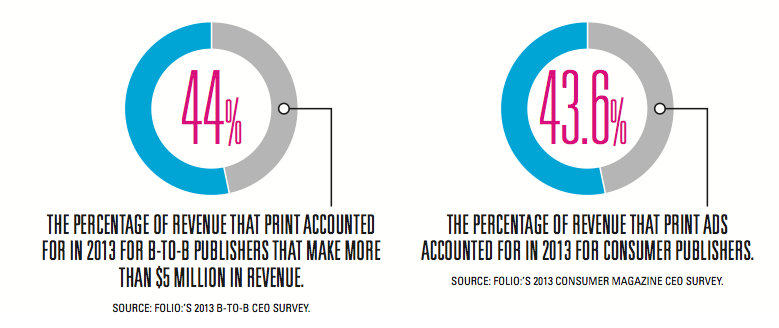
Print revenues overall are just under 50 percent at AIM, with events adding 45 percent to the top line.

Nevertheless, when taking a longer-term view of print AIM is hedging its bets. The outdoor group, for example, is moving much more quickly towards a digital mentality, at least from a customer perspective, where marketers have become very sophisticated with their own earned and owned media efforts. And as that digital favoritism creeps into other markets, print's growth curve becomes pressured. Even now, Active Interest Media has a very conservative outlook for print.
"We don't see print as a growth business for us," Clurman says. "Our strategy is to go find the premier legacy media brands in the special interest markets that we're in, and those are almost entirely print magazine brands. That's the gateway and it gives us access and credibility to do all the other stuff which is to surround the print brand with events, digital and services."
The Influence of Print
At the same time, print still holds a cross-platform influence. "If you let the print brand slip, then people in those markets, whether they're readers or advertisers, will think the brand has lost its luster. That has an impact on everything else we do," says Clurman.


Sunday, December 15, 2013

'Print' NOT Going Softly Into the Night!

I've always suspected it never would - In fact, I still believe 'print' will never go away completely - AND quite possibly will even have a little resurgence :)

Perhaps the answer to the reason why is 'blowin in the wind'.

I believe that two men with the name of Dylan - one as a first name and one as a last name - contributed greatly to my thoughts on this issue in tonight's post.

Dylan Thomas, a Welsh poet (1914 - 1953), wrote the following poem from which I fashioned part of my post's title:

Do Not Go Gentle Into That Good Night 

Do not go gentle into that good night, 
Old age should burn and rave at close of day; 
Rage, rage against the dying of the light. 

Though wise men at their end know dark is right, 
Because their words had forked no lightning they 
Do not go gentle into that good night. 

Good men, the last wave by, crying how bright 
Their frail deeds might have danced in a green bay, 
Rage, rage against the dying of the light. 

Wild men who caught and sang the sun in flight, 
And learn, too late, they grieved it on its way, 
Do not go gentle into that good night. 

Grave men, near death, who see with blinding sight 
Blind eyes could blaze like meteors and be gay, 
Rage, rage against the dying of the light. 

And you, my father, there on that sad height, 
Curse, bless, me now with your fierce tears, I pray. 
Do not go gentle into that good night. 
Rage, rage against the dying of the light. 


And Bob Dylan, an American musician, singer-songwriter, artist and writer, sang this song that points out that many deep questions are, indeed, 'blowin in the wind':


Blowin in the Wind

How many roads must a man walk down
Before you call him a man?
How many seas must a white dove sail
Before she sleeps in this sand?
Yes, an' how many times must the cannon balls fly
Before they're forever banned?
The answer, my friend, is blowin' in the wind
The answer is blowin' in the wind
How many years can a mountain exist
Before it is washed to the sea?
Yes, an' how many years can some people exist
Before they're allowed to be free?
Yes, an' how many times must a man turn his head
An' pretend that he just doesn't see?Jo
The answer, my friend, it is blowin' in the wind
An' the answer is blowin' in the wind
How many times must a man look up
Before he can see the sky?
Yes, an' how many ears must one man have
Before he can hear people cry?
Yes, an' how many deaths will it take until he knows
That too many people have died?
The answer, my friend, is blowin' in the wind
The answer is blowin' in the wind

I just love the emotions expressed by these two Dylans.

Now this 'print' publishing resource article by John P. David in The HuffPost:


Is Print Really Dead?


Recently while waiting for a breakfast meeting to start at a café in Miami's Coconut Grove, I overheard an exchange between a tourist a local who was reading the daily paper. "Where can I get a newspaper around here?" asked the visitor. "Nowhere," said the local.
Newsstands may still be squeaking out income in larger metro areas, but I honestly don't know where to buy a daily newspaper in my market. A convenience store, maybe?
Sadly, the days of robust, metro dailies are over. Daily newspapers, which can't compete with specialist publications or the immediate nature of the Internet, are dying a slow death.
But is all hope lost for print? Recent news suggests otherwise.
Last week, the new owners of Newsweek revealed that the famed weekly magazine will return to print after more than a year out of printed circulation. Publishers said the magazine would mainly be supported by subscriber fees, rather than advertising. Clearly they believe that so-called long-form journalism has a place in print. More on that later.
Other publishers are taking a run at print as well. Earlier this year, Meredith Publishing launched a print magazine based on the popular website allrecipes.com. If you don't cook, you may not know that allrecipes.com is one of the dominant recipe sites online (a recent search for chocolate chip cookies, for example, found more than 1,200 recipes). But if the website draws a ton of traffic to an efficient, online venue, why launch a recipe magazine -- asking people to pay for something they can get for free online? In an interview on Bloomberg TV, the CEO of Meredith explained that most people search online for recipes which they already know or are aware of. However, they will read a magazine to get inspiration or to learn about new recipes. A print magazine, with nice pictures and inventive ideas, can still inspire people to do and buy things in ways that the web can't.


Saturday, June 11, 2011

How To Contract the New Opportunities for Print Buyers

A little RE what should be included in publishers' contracts in todays world of multi-platform publishing.

You see, as I always suspected and posted in previous posts, the growing popularity of digital publishing would produce a tail long enough to also pull print publishing into a new more streamlined, cost-effective era that would synergize its popularity with that of digital...

You can get print fast and cheap today...If you know what to include in the print bid contract.

Interesting stuff!

Details by Bert N. Langford in FOLIO magazine:

Multi-Platform Publishing Offers New Opportunities for “Print” Buyers

If you have not bid out your work to the printing marketplace in the past three or more years, you are likely missing out on a great opportunity, not only in your print deal, but also the growing synergies between digital and print that printers now offer.

Within the following I’ll offer some tips (but not all, due to limited space) on how to conduct printing negotiations in a manner that maximizes your company’s benefits and opportunities.

Your first step is to form an aggressive yet adaptable strategy for how to conduct negotiations and track the comparative results. In all cases, create the comparative

printing analysis based on the same issue makeup found on your printer’s invoice (and reported by the same fiscal month) for the most recently completed fiscal year.

Then below the line, adjust the basic pricing results to consider all costs of doing business with each printer that can occur over the contract term.

This includes each printer’s ROI-proven digital/print Value-Added Program (VAP) of interest to your company. Consider each as another “adjustment” category (as the printer’s pricing is offset by savings/income). But contractually require that your company retains ownership of the data and can move to another printer later, without losing the program’s benefits.

Read and learn more

Get Writers Welcome Blog on your Kindle here


Sunday, December 26, 2010

How Many Authors Are Dumping Their Publishing Houses to Self-Publish?


"Until someone comes up with an algorithm to sort the good manuscripts from the bad, publishers and their human network of agents and editors maintain an advantage," McQuivey said. 'But sooner or later someone will create a new way for readers to find the books they most want to read, and that someone may or may not be a traditional book publisher.'"

Great, previously-traditionally-published authors are jumping from their old publishing houses to self-publishing to take advantage of higher percentage earnings, cheaper operational costs and faster distribution directly to their readers.

New technology, eBook stores, apps and platforms are blooming all over the bloody place!

This phenomonon, coupled with the fact that big plublishing has been lousy "gatekeepers" for at least the past three decades (or since they essentially sold out new authors and talent for their quick bottom-lines--sort of the greedy condition that happened on Wall Street), was exactly the stimuli needed to invent better ways to accommodate writers, recognize more talent and satisfy the vast market of unquenchable readers.

I believe big publishing has always underestimated the reading market.

Further, big publishing became arrogant and got the cart before the horse; putting greater value on just the business of selling a creative commodity over the commodity-creators themselves and just leaving the real producers/artisans chump change.

Alex Pham reports these details in the LA Times:

Book publishers see their role as gatekeepers shrink

Writers are bypassing the traditional route to bookstore shelves and self-publishing their works online. By selling directly to readers, authors get a larger slice of the sale price.

Joe Konrath can't wait for his books to go out of print.

When that happens, the 40-year-old crime novelist plans to reclaim the copyrights from his publisher, Hyperion Books, and self-publish them on Amazon.com, Apple Inc.'s iBooks and other online outlets. That way he'll be able to collect 70% of the sale price, compared with the 6% to 18% he receives from Hyperion.

As for future novels, Konrath plans to self-publish all of them in digital form without having to leave his house in Schaumburg, Ill.

"I doubt I'll ever have another traditional print deal," said the author of "Whiskey Sour," "Bloody Mary" and other titles. "I can earn more money on my own."

For more than a century, writers have made the fabled pilgrimage to New York, offering their stories to publishing houses and dreaming of bound editions on bookstore shelves. Publishers had the power of the purse and the press. They doled out advances to writers they deemed worthy and paid the cost of printing, binding and delivering books to bookstores. In the world of print, few authors could afford to self-publish.

The Internet has changed all that, allowing writers to sell their works directly to readers, bypassing agents and publishers who once were the gatekeepers.

Read and learn more


Wednesday, September 22, 2010

Is the Print Party Ending?


I personally don't feel print media will ever disappear completely and I have said as much previously on this blog...In fact, I believe print will have a rebound attributable, again, to technology. But, more deeply, because there are some things people just want in a more preservable, 3-dimensional format...You know, one you can read when the digital "gadgets" fail for whatever reason.

Marion Maneker, in an article for BNET (The CBS Interactive Business Network), has this take on print media's demise that he has deduced from three recent occurances in the publishing industry:

Will the Last Book Publisher Please Turn Out the Lights?

We’re reaching the end of the party for print – it’s going to go out with a whimper. We might just have even seen the last flickers of fun go out in three relatively small stories in the New York Times late last week and today. Here’s the list: the announcement that Newsweek’s Howard Fineman is moving to the Huffington Post; a brief profile of a near outsider’s hiring for a plum job in the book business; and the ever-sillier spectacle of the Barnes & Noble (BKS) proxy fight. Taken together, they suggest there’s no turning back.

The most important of the three stories is actually the Barnes & Noble takeover fight. Chairman Len Riggio’s intransigence in the face of forces that want to reform and re-energize the company — even as physical book sales continue to evaporate — make it clear that he is incapable of put the best interest of the company ahead of his own and his family’s interests. Here’s Riggio complaining to the New York Times as his company’s stock has dropped nearly 30%:

“I find it almost repulsive I have to be put in a position to defend myself,” Mr. Riggio said last week in Barnes & Noble’s corporate offices, leaning forward to press his point. [...] Barnes & Noble’s new chief executive, William Lynch, is paid $900,000 in salary, while his predecessor, Stephen Riggio, who was also vice chairman, was paid $800,000. Stephen, Mr. Riggio’s younger brother, remains vice chairman and now earns $400,000.

Mr. Riggio — who reduced his salary this year to $100,000 from $300,000 — made no apologies for what he said were necessary costs for hiring good executives. “I’m significantly undercompensated,” he said. “Steve is undercompensated.”

When a controlling shareholder in a company suggests he has to be paid a lot to stay with the firm, you know there’s conceptual disconnect. Riggio’s tortured logic, however, is the least of Barnes & Noble’s problems as a company.

B&N has an interesting history. It transformed the marketplace for books in the era of big box retailing. In the process, B&N added scale and efficiency to the modern publishing industry which in turn allowed publishers to achieve bigger and bigger sales. From the early 1990s, when B&N took the Superstore concept wide — other stores had invented it — until just recently, the sales of the top hardcover titles have increased geometrically.

Where books selling millions of copies was once a generational phenomenon, today it is the norm. Success breeds transformation and the rise of the mega-book attracted new retail outlets like Walmart (WMT), Costco (COST) and Amazon (AMZN) to the book business. These sales channels proved even more efficient — and offered greater discounts — than B&N. They did to the book chains exactly what the chains did to independent stores. Already weakened on that front, and further imperiled by the financial crisis and the damage it has done to all retailing, B&N faced a second front fighting off digital distribution of books.

Read more http://alturl.com/6b2rn